


KDI: Public data on political integrity must be interconnected to strengthen accountability
Pristina, 24 April 2026
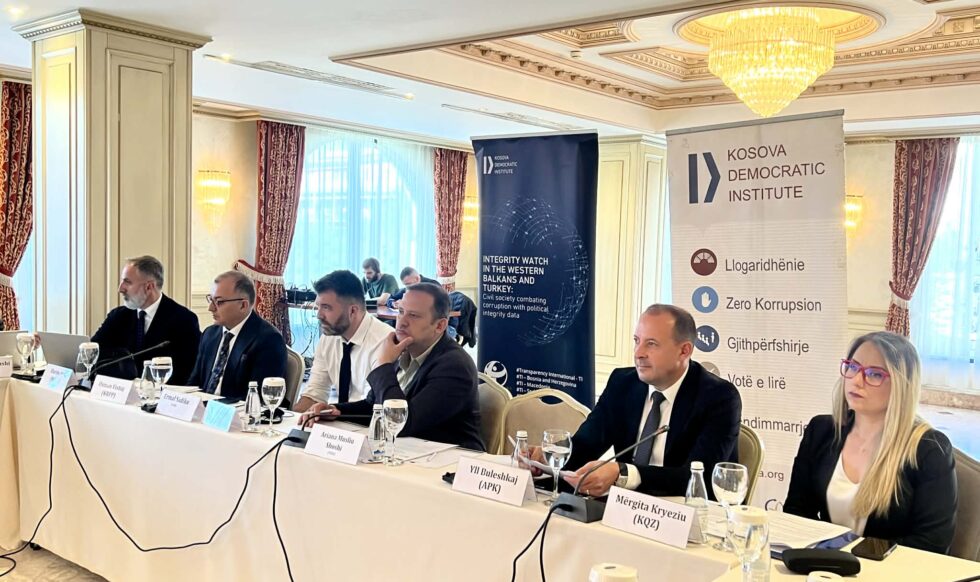
The Kosovo Democratic Institute (KDI) today organized a roundtable discussion titled “Strengthening Political Integrity through Digitalization”, where key findings were presented on the legal, institutional, and digital challenges affecting political integrity in Kosovo.
The event brought together representatives of relevant institutions, including Members of the Assembly of Kosovo, the Agency for Prevention of Corruption, the Public Procurement Regulatory Commission, the Central Election Commission, OGP Kosovo (Open Government Partnership), civil society, and representatives of international organizations in Kosovo, to discuss the interaction between asset declarations, political financing, and public procurement as three fundamental pillars of political integrity.
In her presentation, Ms. Diana Metushi-Krasniqi from KDI emphasized that, despite progress in transparency, the data ecosystem on political integrity remains fragmented and insufficiently aligned with open and machine-readable data standards, thereby hindering effective accountability of public officials.
KDI’s analysis show that Kosovo has developed a relatively advanced legal framework in key areas of political integrity; however, implementation remains weak, and public data continues to be fragmented, non-standardized, and not interconnected.
Furthermore, the digital platform Integrity Watch Kosova, launched by KDI last year and linking various political integrity datasets, has demonstrated that real corruption risks exist in the public sector.
The main findings indicate that:
In this context, KDI underlines that the current system produces formal transparency but fails to translate it into real accountability due to the lack of active use of data for analysis and decision-making.
Institutional representatives in the panel emphasized the importance of strengthening inter-institutional cooperation and advancing digitalization:
Member of the Assembly of Kosovo, Mr. Ermal Sadiku, highlighted that the digitalization of public policies and practices is no longer a future aspiration but a present necessity, and that politics must make a concrete commitment to its implementation in order to increase government efficiency, transparency, and decision-making quality. He further stated that “the discourse on artificial intelligence remains empty if institutions continue to operate with bureaucratic processes and fragmented systems, and that digital transformation requires a fundamental change in how the state manages data and builds services for citizens.”
The Director of the Agency for Prevention of Corruption, Mr. Yll Buleshkaj, emphasized that “digitalization is making transparency more accessible and efficient, but without political will and support for data publication, public integrity risks remaining only a functional platform rather than a tangible reality for citizens.”
Meanwhile, the Chair of the Board of the Public Procurement Regulatory Commission, Mr. Osman Vishaj, stated that digitalization in procurement has marked significant progress; however, without addressing contract management, the lack of technical capacities, and the integrity of procurement officials, the real risk remains in how funds are spent rather than how procedures are conducted.
On the other hand, Ms. Mërgita Kryeziu, Head of the Unit for Financial Control of Political Entities at the Central Election Commission, noted that publishing data on political financing is an important step toward transparency, but without digital mechanisms for analysis and early detection of irregularities, oversight risks remaining a formal exercise in the face of the real complexity of political financing.
Furthermore, Mr. Flurim Arifi, Director of the Department for Digitalization of Municipal Services at the Ministry of Local Government Administration, Division for the Open Government Partnership (OGP Kosovo), stated that Kosovo’s membership in the Open Government Partnership marks an important step for the country, but its success will be measured not by action plans, but by the actual implementation of commitments on transparency, integrated digital services, and active citizen participation in decision-making.
The discussion also highlighted the need for a more proactive approach to using data for investigation, oversight, and corruption prevention.
In response to the identified challenges, KDI calls for concrete and immediate action from institutions:
This activity was organized within the framework of the regional project “Integrity Watch in the Western Balkans and Turkey”, with financial support from the European Union. Its content is the sole responsibility of the Kosovo Democratic Institute (KDI) and does not necessarily reflect the views of the European Union.